Self-hosted backup control plane · Linux-native · secure by design

One recovery assurance platform
for every
database backup.

DBAegis brings backup scheduling, restore safety, validation evidence, destinations, notifications, backup history, secure access controls, and recovery metadata into one modern interface so teams stop babysitting scattered scripts, cron jobs, cloud consoles, and shared credentials.

No SaaS lock-in LDAP + local users TLS-secured access Encrypted credentials S3 / Azure / GCS / local System snapshots
18+database engines
1×single self-hosted surface
4storage target families
24/7clear backup visibility
DBAegis — Backup Operations Center live product view
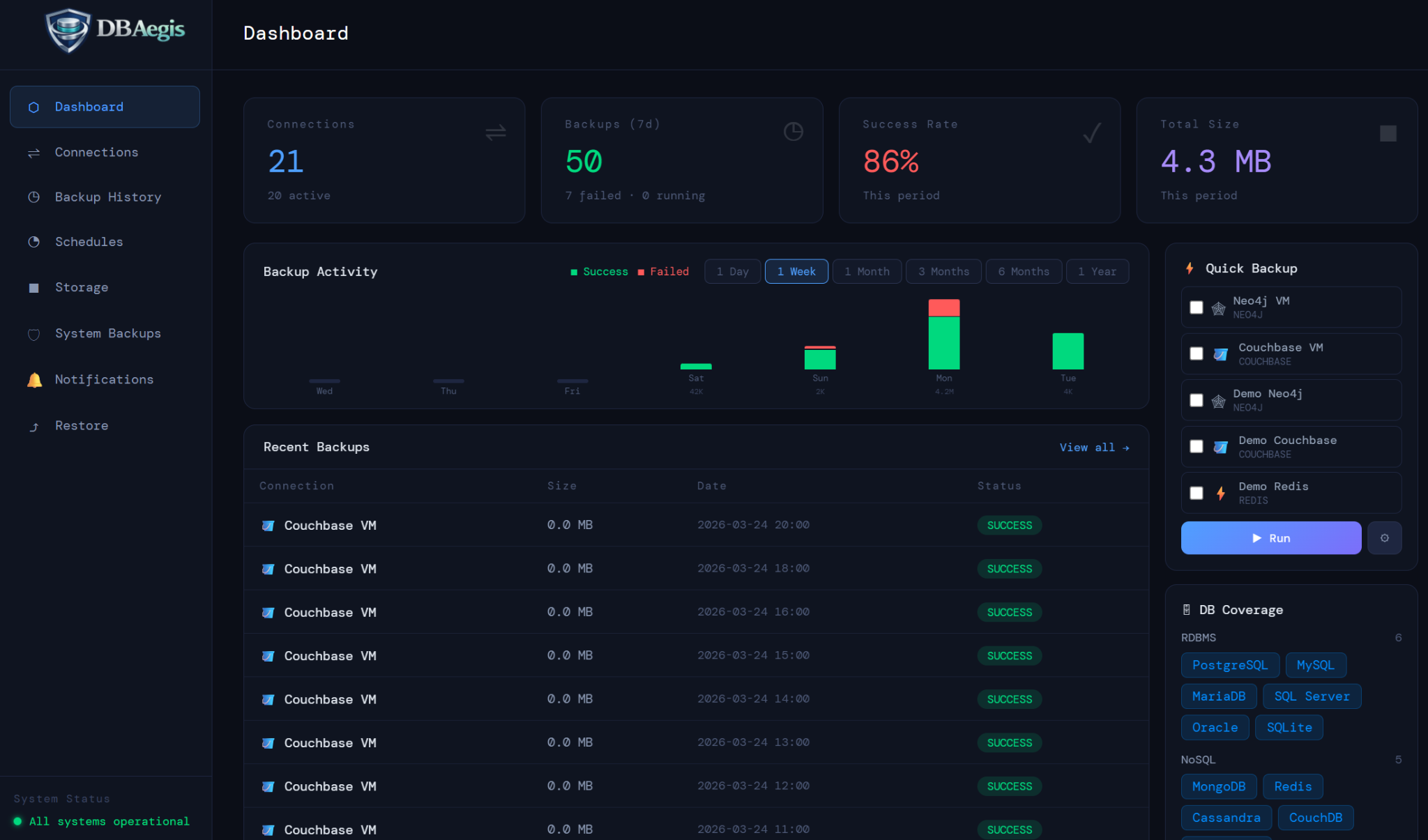
DBAegis dashboard screenshot
Connection catalog DBAegis connections screenshot
Operator signal Schedules, history, alerts Everything the team needs without page-hopping.
Deploy anywhere VM friendly Self-hosted Linux install, cloud or local destinations, under your control.
Dashboard-first operations

Connection counts, backup activity, recent runs, and quick actions live in one place.

LDAP + local users

Use optional LDAP sign-in while keeping local accounts available for controlled platform access.

Destination-aware storage

Only valid target combinations surface, so operators avoid impossible or unsafe choices.

TLS-enabled access

Secure communication, certificate verification, and SSL/StartTLS support fit security-conscious environments.

Encrypted secrets

Connection passwords and related credentials are stored in encrypted form for stronger operational safety.

Restore safety controls

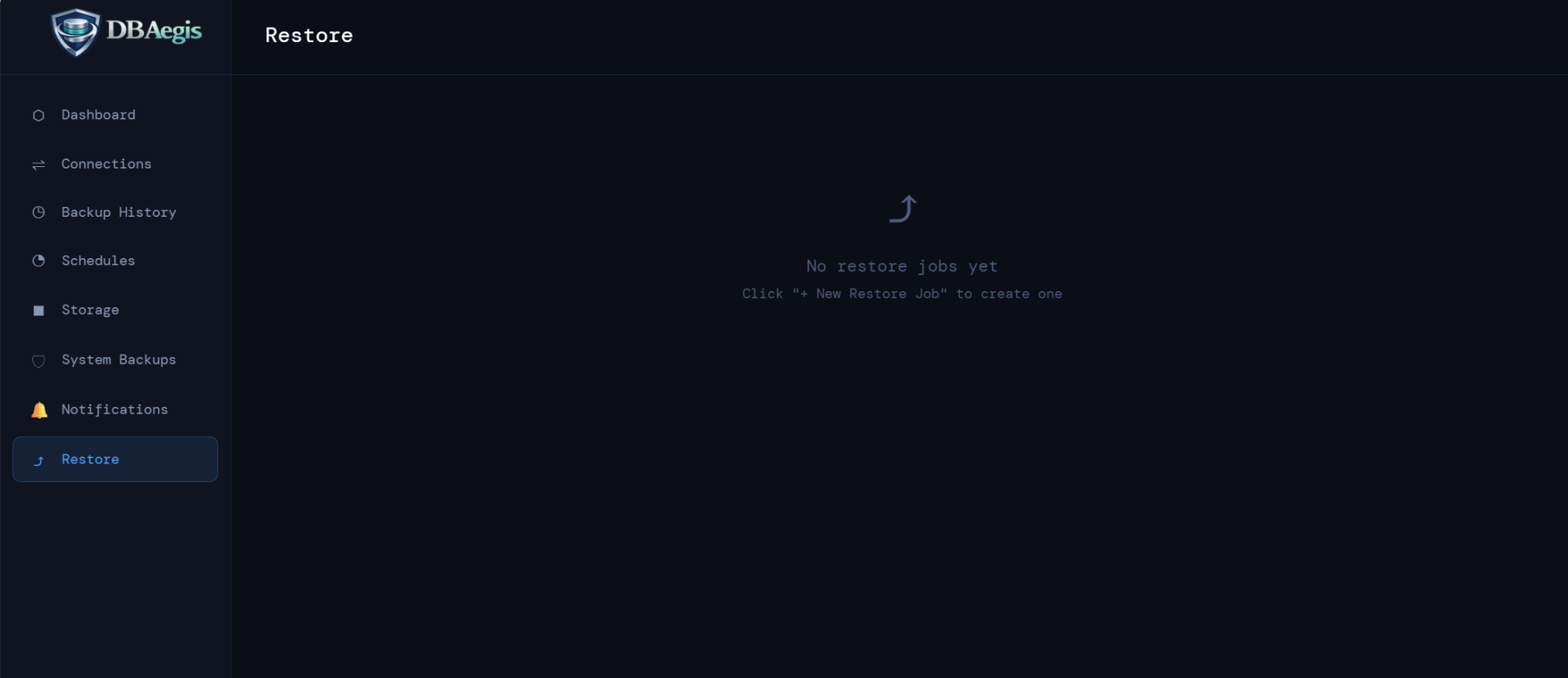
Dry runs, reason capture, password re-authorization, typed high-risk confirmation, and audit fields make recovery safer.

Protect the control plane

System snapshots preserve DBAegis metadata and configuration for safer recovery.

Why DBAegis

Operational clarity, secure access, and guardrails in one self-hosted surface.

DBAegis gives database teams a polished control plane for backup operations across mixed estates, with security features that fit enterprise environments instead of getting bolted on later.

🔌

Unified connection catalog

Bring Oracle, PostgreSQL, MySQL, MariaDB, SQL Server, Azure SQL, SQLite, MongoDB, Redis, Cassandra, Couchbase, CouchDB, Neo4j, ClickHouse, Snowflake, Cosmos DB, DynamoDB, Firestore, and more into one consistent control surface with visible health, direct actions, and less operator guesswork.

health visibility test + backup now single list
📅

Schedules and backup history that stay connected

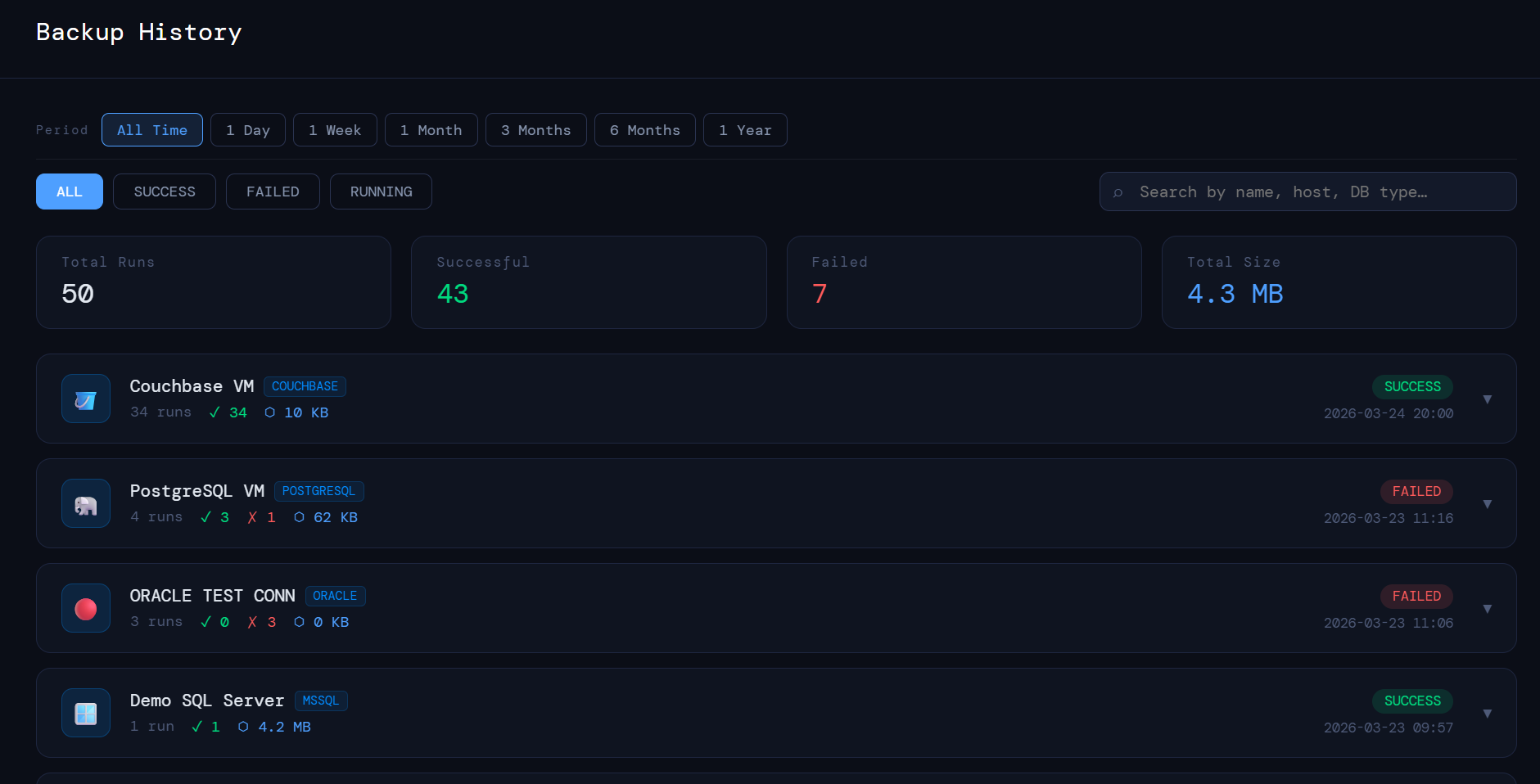
Instead of hiding outcomes in logs, DBAegis keeps recurring jobs, recent runs, sizes, and statuses visible where operators actually work.

recurring jobs per-run history
🗄️

Destination filtering

Valid storage options only. Fewer broken paths, fewer wrong clicks, and clearer destination setup across engines.

local S3 Azure GCS
👥

LDAP authentication and local users

Support centralized identity with optional LDAP sign-in while keeping native DBAegis users for local administration, break-glass access, and controlled onboarding.

LDAP auth admin/read_only local access
🔐

TLS and encrypted secrets

TLS-secured access, certificate verification, SSL/StartTLS options, and encrypted storage for connection passwords make the control plane safer for real environments.

TLS enabled cert verify encrypted at rest
⚙️

Self-hosted by design, with alerting built in

Linux-native deployment, zero forced SaaS dependency, styled email notifications, webhook support, and compatibility with both cloud and local storage make DBAegis feel like an infrastructure product instead of a generic dashboard veneer.

FastAPI SMTP + webhooks Docker Compose Nginx + systemd SQLite
Restore safety

Backups are useful. Proven, controlled recovery is what buyers trust.

DBAegis makes restore a governed workflow instead of a dangerous one-click operation. Operators can prove intent, validate the path, and preserve evidence before high-risk recovery work proceeds.

🧪

Dry-run restore validation

Validate restore inputs, destination compatibility, selected backup artifacts, and execution readiness before running the actual restore.

precheckless risk
📝

Restore reason capture

Require operators to document why a restore is being performed so audit trails contain operational context, not just timestamps.

audit reasoncompliance
🔑

Password re-authorization

Critical restore actions can require password confirmation so destructive work is tied to an intentional authenticated decision.

reauthoperator control
⚠️

High-risk typed confirmation

For destructive or production-sensitive restores, typed verification helps prevent accidental execution and makes the risk obvious before action.

typed confirmproduction-safe
📜

Full restore audit fields

Capture who restored, what was restored, when it happened, why it happened, and which backup artifact or destination was involved.

whowhatwhenwhy
Product focus

A product experience that makes backup operations legible in seconds.

Real screens show how teams move from connection inventory to schedules, backup history, notifications, access control, and recovery without leaving the same operating surface.

Dashboard overview real screenshot
DBAegis dashboard overview
01

Immediate operational context

Connection count, backup totals, success rate, recent activity, quick actions, and engine coverage all appear on the first screen so teams understand platform state immediately.

02

Clear operator journey

The product flow is straightforward: connect databases, choose destinations, schedule jobs, monitor results, receive alerts, manage access, and recover with confidence.

03

Security belongs in the same surface

User management, LDAP controls, TLS settings, and encrypted secret handling extend the same polished experience to platform security—not just backup execution.

Core workflow

The core workflow, from connections to monitoring and alerts.

Lead with the screens that show the everyday operator journey: inventory, job orchestration, backup outcomes, notifications, and destination management.

Access & Security

LDAP authentication, local users, TLS, and encrypted credentials.

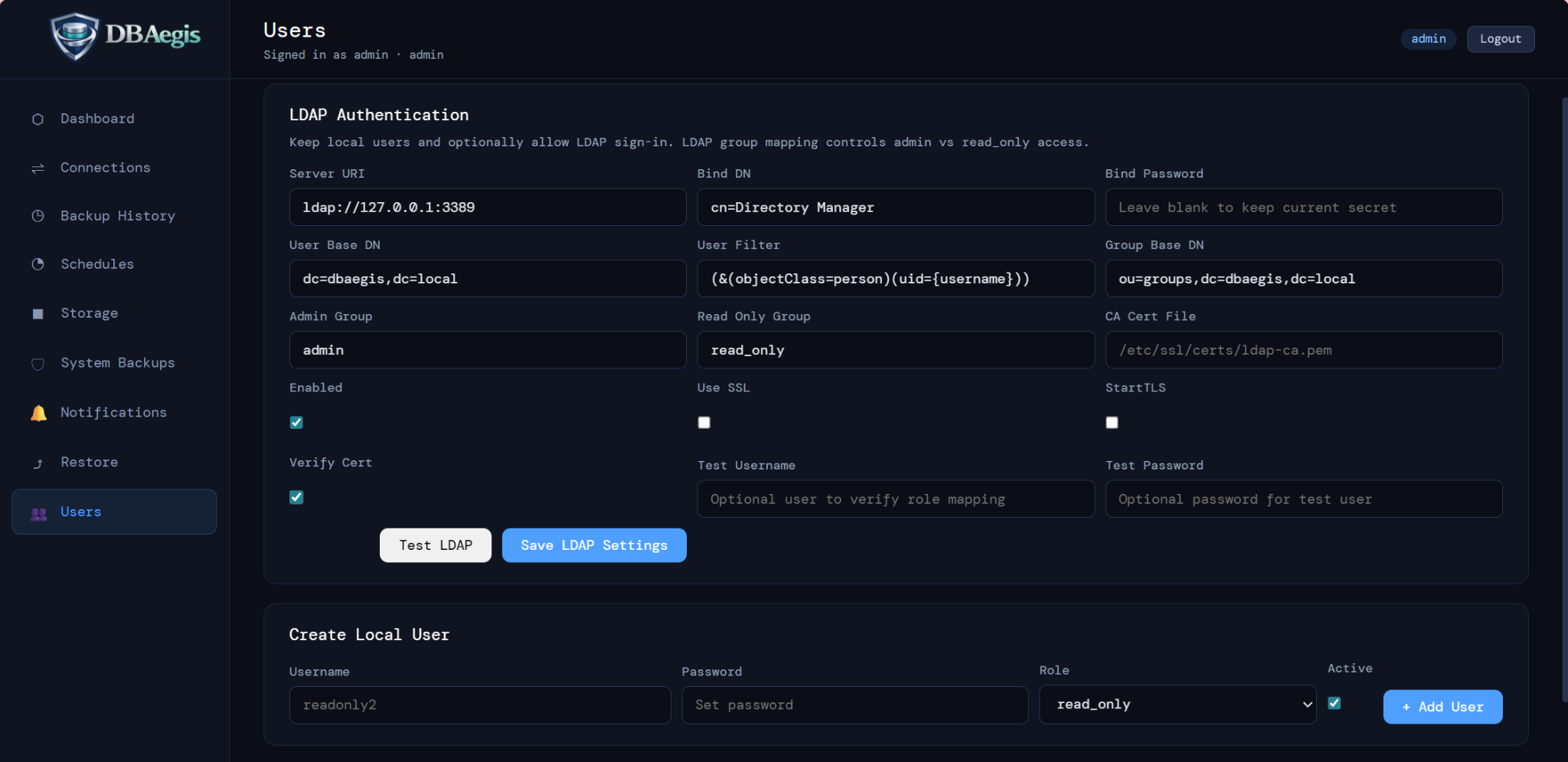
DBAegis secures the backup control plane with optional LDAP sign-in, local user management, role mapping for admin and read-only access, TLS-enabled communication, and encrypted storage for connection passwords.

Authentication & role mapping LDAP + local
DBAegis LDAP authentication and local user management screen
01

Optional LDAP sign-in

Connect DBAegis to LDAP when centralized identity is required, while still keeping local users available for direct platform administration.

02

Role mapping with clear boundaries

Map directory groups to admin and read-only roles so operators get the access they need without relying on shared credentials.

03

TLS, certificate checks, and test workflows

TLS can be enabled, certificate verification is supported, and LDAP settings can be tested before save for safer rollout in real environments.

What this adds

Security details buyers actually want to see.

These controls make DBAegis feel production-ready for teams that care about access discipline and platform security—not just successful backups.

LDAP + local accounts

Use centralized sign-in and keep native users for controlled local access.

Admin / read-only roles

Group mapping and role selection make permissions clearer across teams.

SSL / StartTLS support

Secure directory communication options fit more enterprise deployment patterns.

Certificate verification

Validate trust chains instead of treating authentication setup as a blind form.

Encrypted connection passwords

Stored secrets are encrypted for stronger operational security.

User lifecycle visibility

Status, source, and last-login details help administrators manage access cleanly.

Positioning

Show the difference between scattered backup ops and a real control plane.

This contrast makes the value obvious for technical buyers: less fragmentation, more visibility, better guardrails, and cleaner security around access and credentials.

Without DBAegis

What backup operations often look like today.

×
Scattered scripts and cron jobs

Ownership is fuzzy, failures are quiet, and knowledge stays trapped in one operator's head.

×
No single health view

Teams bounce between servers, cloud consoles, shell history, and ad hoc notes to understand what happened.

×
Access sprawl and shared credentials

Authentication often lives outside the workflow, which leads to inconsistent permissions and weak secret handling.

×
Recovery confidence is low

Even the backup management layer itself may not be protected or documented well enough.

With DBAegis

What teams get from day one.

One visible operating surface

Connections, schedules, destinations, history, and alerts live together in a single backup command center.

Cleaner operator workflow

The product reduces context switching and turns backup operations into a consistent team process.

Guardrails built into the UI

Destination filtering, structured forms, and safer setup flows make the system feel more deliberate.

Secure access and secret handling

LDAP and local users, TLS-enabled communication, encrypted passwords, and system snapshots reinforce the reliability message.

Coverage

Mixed database estate? Keep one visual language across backups, access, and storage.

Buyers should instantly see breadth, storage options, operator workflow, and the security controls that sit around the backup control plane.

Database engines

18+ relational, NoSQL, graph, analytics, and cloud-native engines under a single operational model.

Oracle PostgreSQL MySQL MariaDB SQL Server Azure SQL SQLite MongoDB Redis Cassandra Couchbase CouchDB Neo4j ClickHouse Snowflake Cosmos DB DynamoDB Firestore

Storage + operating principles

Cloud and local destinations with guardrails, visibility, self-hosted control, and secure operator access.

Local filesystem S3-compatible Azure Blob Google Cloud Storage
Manual + scheduled runs

Start jobs on demand or keep them recurring and visible.

Destination guardrails

Only valid target combinations surface in the UI.

LDAP + local users

Support centralized identity while preserving local platform control.

TLS + encrypted secrets

Secure communication and encrypted passwords strengthen the platform posture.

SMTP + webhooks

Notify the right people without extra wiring.

System snapshots

Protect the DBAegis control plane itself.

Validation evidence

Not just integrated — validated with real smoke reports and cleared tasks.

DBAegis should show buyers which engines and storage targets were actually exercised. Publish smoke report status, last validation dates, and cleared PENDING_TASKS items as product evidence.

Engine validation

Show backup and restore evidence for PostgreSQL, Oracle, MongoDB, Redis, Couchbase, Cassandra, Neo4j, Snowflake, ClickHouse, and cloud engines as they are validated.

☁️

Storage validation

Separate local, S3-compatible, Azure Blob, and Google Cloud Storage evidence so buyers understand proven deployment paths.

📈

Smoke reports

Expose live smoke report summaries, pass/fail history, and validation notes without publishing secrets or sensitive test infrastructure.

🧾

Cleared tasks

Use PENDING_TASKS.md progress to show that validation gaps are actively tracked, cleared, and converted into product confidence.

Packaging

Clear editions without forcing public list pricing too early.

Keep “pricing available on request,” but help buyers understand the likely package fit before they contact you.

🌱

Community

Core backup/restore workflows for labs, small teams, and evaluation environments with limited engine scope.

starterself-hosted
🚀

Professional

Multi-engine backup operations, scheduling, cloud storage destinations, notifications, and operational dashboards.

commercialsupport option
🏢

Enterprise

LDAP, RBAC, audit controls, advanced restore protection, security hardening, and priority deployment assistance.

enterprisesupport included
🛠️

Custom deployment

Air-gapped installs, enterprise rollout, custom engine enablement, migration help, and managed DBAegis operations.

customILOGICSOFT
Roadmap

Highest-value next feature: scheduled restore verification.

Backup success is only half the story. Scheduled restore drills prove recoverability by periodically restoring backups into controlled validation targets and reporting recovery readiness.

🔄

Scheduled restore drills

Automatically test selected backups on a schedule, capture logs, verify restore completion, and produce recoverability evidence for audits and operations reviews.

☁️

Direct-to-cloud backup

Reduce staging by writing backup artifacts directly to supported cloud destinations where each engine allows it.

🤖

AI failure diagnosis

Summarize failures, suggest next actions, and help operators troubleshoot backup and restore issues faster.

Deployment

Self-hosted should feel secure, polished, and easy to trust.

Give deployment equal weight so buyers instantly understand control, simplicity, fit, and how the platform handles security in self-hosted environments.

DBAegis ships for self-hosted Linux environments with a lightweight stack that is easy to explain, easy to trust, and ready for teams that need secure operator access.

FastAPI backend with a single-file HTML/JS frontend.

SQLite internal database with zero mandatory external services.

Nginx reverse proxy and systemd support for VM-native installs.

Docker Compose support for teams that prefer containers.

Works with cloud storage targets and local filesystem destinations.

TLS-enabled access, LDAP support, and encrypted credential handling fit security-conscious deployments.

Request deployment guide See coverage
install.sh — bash
# Copy DBAegis onto your Linux VM
$ scp dbaegis.tar.gz user@vm:/opt/
dbaegis.tar.gz 100% 12MB 4.2MB/s 00:02

# Extract and install
$ tar -xzf dbaegis.tar.gz && cd dbaegis
$ sudo ./install.sh
✓ Dependencies resolved
✓ systemd service registered
✓ Nginx config written
✓ SQLite database initialized

$ sudo systemctl start dbaegis
✓ DBAegis running on :8080
→ Open http://your-vm-ip:8080

$
Explainer + flash cards

Teach buyers and operators how DBAegis works in minutes.

The product explainer and backup/restore flash cards are now bundled with the site and connected to the DBAegis Assistant.

Assistant-ready knowledge

Product story + operator Q&A in one place.

Use the explainer for website visitors, demos, and investor conversations. Use the flash cards for quick answers about logical backups, physical backups, S3/GCS/Azure destinations, cloud staging, prechecks, and restore safety.

Explainer video15-scene interactive HTML product walkthrough with voice-ready script.
Flash cards70 backup and restore cards searchable from a standalone page.
AI assistantLocal fallback answers now include backup/restore learning topics.
Demo flowVisitors can watch, learn, ask, then request a walkthrough.
Open full explainer Open flash cards
IL
Built by ILOGICSOFT

Built by database operators for teams that run critical data platforms.

DBAegis is backed by ILOGICSOFT, a consulting team focused on database performance, cost optimization, HA/DR, managed support, and cloud database operations across Oracle, MongoDB, Cassandra, Redis, Snowflake, and PostgreSQL.

Visit ILOGICSOFT ↗
Next step

Bring backup operations, secure access, and recovery confidence into one interface.

DBAegis is built for teams that want self-hosted control, clean operational visibility, LDAP and local user management, TLS-secured access, encrypted credentials, and confident recovery workflows.

🤖
DBAegis Assistant
online · ready to help
assistant available
DBAegis AI
Hi! I'm the DBAegis assistant. Ask me about 18+ supported database engines, restore safety, support matrix, validation evidence, backup and restore flash cards, the explainer video, LDAP and local users, TLS, encrypted credentials, deployment, storage destinations, pricing, roadmap, or ILOGICSOFT services.
What databases are supported? How does LDAP auth work? How are passwords protected? How does deployment work? Show me flash cards Open product explainer Tell me about ILOGICSOFT